
01
Technical pack
Editable drawings, BOM, finish schedule and packaging specification in your name.
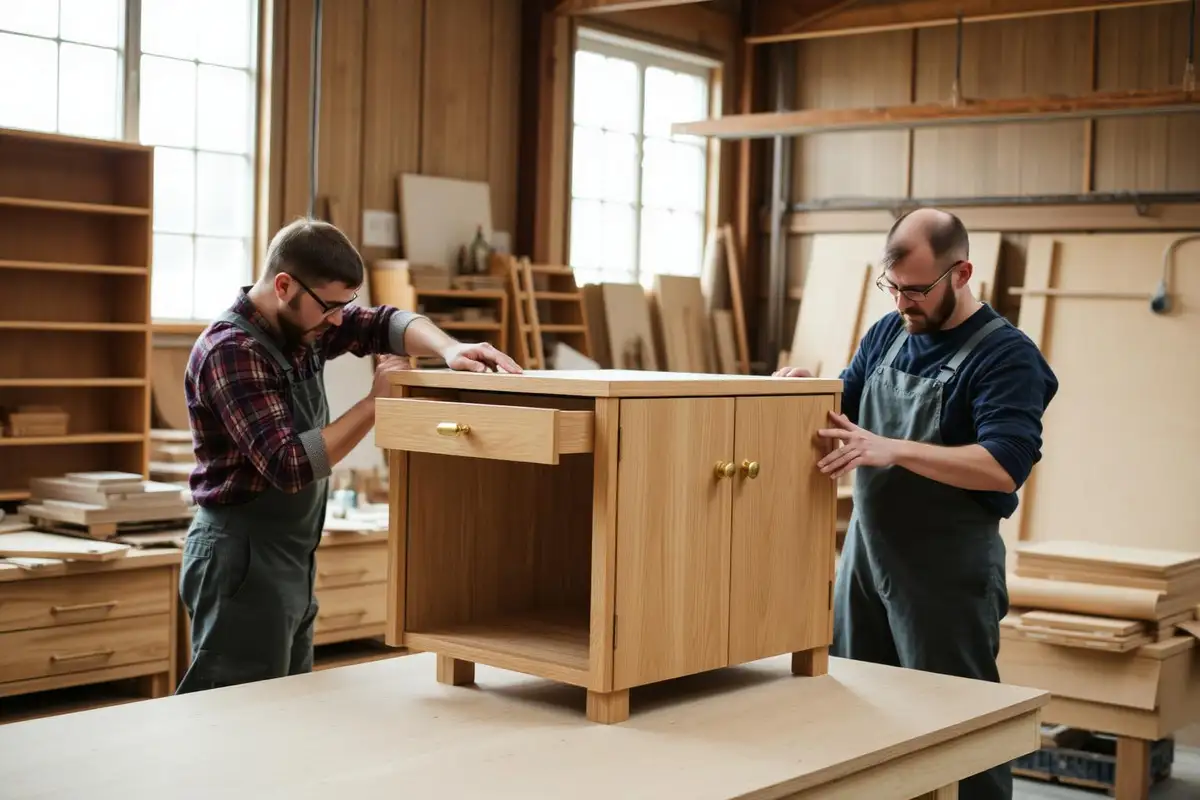

We find and match the factory that should make your product, then get it made and delivered to Greece. Furniture, joinery, doors, lighting, stone and metalwork for Greek businesses, hotels, developers and owners ordering in quantity — a drawing or a photograph becomes a technical pack, three qualified makers in Italy, Spain, Portugal, Turkey, China or India quote against it, and the chosen one produces under inspection with the landed cost in Greece fixed before you commit.
We shortlist three plants that genuinely make your product category — solid timber is not melamine, die-cast lighting is not assembly — and verify that each owns its machines rather than subcontracting the work. Each quotes against the same technical pack, so you see unit cost, tooling, minimum order, production time and landed cost in Greece side by side before you choose.
You own the drawings, the tooling and the supplier relationship. We build them for you — we do not hold them hostage.
We assess whether the product can be made at your target price and quantity and delivered into Greece at a cost that works, and say so honestly before you spend anything. If the numbers do not work, we tell you what would need to change.
Everything produced during development is handed over to you. If you later want to run the factory relationship directly, you can — with the full file in your hands.
Editable drawings, BOM, finish schedule and packaging specification in your name.
Sealed, photographed reference unit with the signed approval record.
Unit, tooling, freight and landed cost in Greece with volume break points.
Matched factory details, contacts, terms, compliance documents and inspection history.
Custom manufacturing is treated as mysterious, but it is a sequence of ordinary decisions taken in the right order — and the most important one is which factory. This is that sequence, written the way we run it, with the traps that cost Greek buyers the most money marked along the way.
The first question is never how it looks; it is whether the target price is achievable at your quantity, delivered into Greece. Material cost, labour, tooling, freight volume and any duty set a hard floor. A sofa that must land at a certain price cannot carry a frame, a foam grade and a fabric that together exceed it, however good the design.
We run that arithmetic first, from real factory inputs, and tell you early if the concept needs to change — a different substrate, a simpler assembly, a knock-down structure that ships flat and fills a container properly. Skipping this step means months of drawings for a product that could never have been sold profitably.
Cost is a design input, not a result you discover at the end.
Factories do not price ideas; they price documents. A quote given against a photograph is a guess that will be corrected upwards later, or delivered as the cheapest interpretation available. The pack removes that: every dimension, board thickness, hinge model, finish code and carton.
It also makes competing quotes meaningful. Three factories quoting against one identical pack produce three comparable numbers. Three factories quoting against a conversation produce three different products at three different prices, and the cheapest is almost always the least specified.
Dimensioned, exploded and assembly views with tolerances stated.
Named brands and models for hardware, not generic descriptions.
Referenced to recognised colour and gloss standards, with physical chips.
Carton, protection, pallet configuration and Greek-language labels.
Many first-time custom projects are quoted by trading companies presenting themselves as manufacturers. A trader is not always a problem, but you must know which you are dealing with, because a trader's quality is only as good as the workshop it subcontracts, and you cannot see it.
We verify who owns the machines, visit the plant and check that what runs on the floor matches what you are buying. A factory that excels at melamine cabinets is usually wrong for solid timber. Country matters too: an EU factory ships to Greece without customs, a non-EU one needs a correct TARIC classification and documents that survive a customs check.
Prototype phases fail when feedback arrives as opinions rather than instructions. We convert every comment into a numbered change with a responsible party and a date, and each new sample is assessed against that list only. Three rounds is usually enough; ten means the brief was never fixed.
Compliance runs alongside, not after: a door, window or stone product sold in Greece needs CE marking and a Declaration of Performance in Greek, and finding that out after production means a container you cannot legally sell or install. The output is a sealed, signed golden sample with its documents attached.
Feedback becomes a numbered change list, not a conversation.
Any factory can produce an impressive first run under attention. Consistency across the second, fifth and tenth order is what decides whether your product line survives, and it comes from documentation — locked specification, version control, retained golden sample, inspection at every run — not goodwill.
We also plan the unglamorous parts upfront: spare components so one broken part does not scrap a unit, packaging revised once real damage data exists — island deliveries show weaknesses fast — and a volume ladder that tells you what changes if your order doubles.
Version-controlled pack; no silent substitutions between runs.
Golden sample held for comparison against every future batch.
Hardware and components stocked in Greece so single failures are repairable.
Documented price and production-time effect of scaling the order up.
By category first, then by proof. We look for plants whose own production floor already makes your type of product, check on site that they own the machines, can meet your quantity and can document the product for the EU, and then let three of them quote against one technical pack. The best price on a vague brief is rarely the right factory.
It depends on the category and on how much tooling the product needs: upholstery and lighting usually need longer runs than stone, metalwork or joinery, which can be made in small batches. We confirm the real minimums during factory matching, before you commit to anything.
All of them. A hotel ordering doors and furniture for every room, a developer specifying kitchens for a block of flats, or an owner building a villa — including foreign owners building in Greece — face the same question: which factory should make this, and will it arrive right. Private label is one use; one-off project production is another.
Construction products covered by a harmonised European standard — doors, windows, tiles, many stone and insulation products — need CE marking and a Declaration of Performance from the manufacturer, supplied in Greek. Furniture and lighting follow other EU safety rules, with Greek instructions and warnings. We build them into development.
Yes. Italy, Spain and Portugal ship into Greece inside the EU with no customs, shorter transit and smaller batches; Turkey is close and, for most industrial goods, inside a customs union with the EU; China and India usually win on unit cost at volume but add customs, longer transit and more inspection. The landed cost decides.
We can develop a product inspired by a reference while respecting registered designs and patents. Where a reference is protected, we redesign the elements that matter so you own a legitimate product rather than a liability.
You do. Tooling you pay for is registered to you, and the technical pack is delivered in editable form in your name. We do not lock clients into our file.
Send a sketch, a photo or a product you like. We will tell you which kind of factory should make it, whether it can be made at your price, and what the first run would cost landed in Greece.