01 / 04
Quantities taken off the drawings
Blocks, mortar, mesh and render calculated per wall area with a realistic waste allowance, so the site isn't ordering twice.
Take-off per m² of wall and floor
Clay and concrete blocks, cement, mortars, screeds, renders and reinforcement.
Clay blocks and concrete blockwork, cement and lime binders, masonry mortars, machine-applied and hand renders, levelling and structural screeds, mesh and reinforcement accessories. We take the quantities off your drawings, schedule deliveries against the build sequence, and price the shell as one package instead of a dozen counter tickets.

Nobody loses money on the price of cement. They lose it on unnecessary deliveries, materials left out in the rain, a render that comes off because the wrong primer went underneath, or a screed poured too thick to dry in time for the tiler. The materials are simple; getting the sequence and the spec right isn't.
The shell is the least glamorous line on the budget and the easiest one to lose money on through bad ordering.
We take the quantities off your drawings, add a realistic allowance for waste, and schedule deliveries so the crew always has what it needs. Render is matched to your actual wall type, and screeds are matched to whatever goes on top — including any underfloor heating already in the package.
Blocks, mortars, render and screed are quantified from your drawings and delivered on your build sequence as a single priced package.
Blocks, mortar, mesh and render calculated per wall area with a realistic waste allowance, so the site isn't ordering twice.
Take-off per m² of wall and floor
Shell materials land in the order the crew needs them, not all at once on a site with nowhere to store them.
Phased deliveries matched to the programme
Binder, aggregate, mortar, mesh, beads and screed on a single PO instead of five merchant accounts.
Whole shell package on one order
Concrete, blockwork and insulation each need a different primer and render class. We specify per surface.
Primer and render class specified per substrate
Clay blocks, thermal blocks, concrete blockwork and facing brick in standard project formats
Cement, lime, ready-mixed masonry mortars and thin-joint adhesives
Machine-applied cement and gypsum renders, lime renders, finishing coats and skim
Levelling, structural and fibre-reinforced screeds, plus self-levelling compounds
Mesh, fibres, corner beads, stop beads, wall ties and movement joint profiles

One take-off, one programme, one supplier.
From foundation to final render coat, we quantify the shell in one pass and deliver in phases that match your site, with thermal block options where they help your energy target.

Partitions, levelling and plaster in the right order.
Renovation work happens in occupied or tight buildings, so we calculate quantities carefully to avoid both a second delivery and surplus stacked in the hallway.

A render is only as good as what's underneath it.
Each wall type needs its own primer and render — we specify the layers as a matched system so the finish coat doesn't come loose.

A shell programme sized for a fixed opening date.
Hotel and resort builds run against a season deadline that a materials shortage can't be allowed to touch, so we quantify the full shell early and phase delivery to your contractor's actual programme, holding buffer stock for the unavoidable site delay, without stopping the render crew on a Friday afternoon.
A proper take-off with an honest waste allowance beats a guess every time — and avoids costly re-orders.
Using the wrong mortar with a thermal block cancels out its benefit — we get this right from the start.
Primer, base and finish coat from one compatible system, not mixed and matched — that's where debonding starts.
Thickness and drying time depend on the finish above and any underfloor heating in the floor.
Cement products absorb moisture from a wet site — we schedule delivery to keep bags dry.
Materials spoil, pallets block the site, and cash sits idle — phased delivery avoids both.
The most common cause of a render cracking or coming loose — the primer costs far less than redoing it.
We either design it thinner or specify a faster-drying product to keep the programme on track.
Representative selections from the catalog — indicative of what we quote, stock-source and deliver week to week. Ask for the full schedule with formats, finishes and current lead times.
01Clay blocks, thermal blocks, concrete blockwork and facing brick in standard project formats
02Cement, lime, ready-mixed masonry mortars and thin-joint adhesives
03Machine-applied cement and gypsum renders, lime renders, finishing coats and skim
04Levelling, structural and fibre-reinforced screeds, plus self-levelling compounds
Blocks, mortars, render and screed are quantified from your drawings and delivered on your build sequence as a single priced package. This is the part most suppliers leave out: what we import, how masonry, screeds & renders should be specified before anyone prices it, where projects lose money, and what our 3–10 days lead time actually covers.
Clay blocks and concrete blockwork, cement and lime binders, masonry mortars, machine-applied and hand renders, levelling and structural screeds, mesh and reinforcement accessories. We take the quantities off your drawings, schedule deliveries against the build sequence, and price the shell as one package instead of a dozen counter tickets.
Because we buy masonry, screeds & renders directly from the factories, the range you see is the range we can programme — not a catalogue we hope to source later. In practice that means blocks & bricks, binders & mortars and renders & plasters, each with its own price band and availability, so a specification can be tuned to a budget instead of abandoned.
Quantities taken off the drawings: blocks, mortar, mesh and render calculated per wall area with a realistic waste allowance, so the site isn't ordering twice.
The shell is the least glamorous line on the budget and the easiest one to lose money on through bad ordering.
Blocks, mortar, mesh and render calculated per wall area with a realistic waste allowance, so the site isn't ordering twice.
Shell materials land in the order the crew needs them, not all at once on a site with nowhere to store them.
Binder, aggregate, mortar, mesh, beads and screed on a single PO instead of five merchant accounts.
Concrete, blockwork and insulation each need a different primer and render class. We specify per surface.
Specifying masonry, screeds & renders well comes down to a short list of decisions taken in the right order — we quantify before we order, we match the mortar to the block, we spec render as one system and we design the screed for what sits on it. Taken on paper, these cost nothing. Taken on site, each one is a change order.
We write the specification with you before anything is quoted, so the number you get is for the material that will actually be installed. That means confirmed dimensions and finishes, the right performance class for the space, and quantities that include the waste factor rather than discovering it mid-installation.
The same reference behaves differently depending on where it goes — new-build shells, full renovations, partition and infill walls, floor levelling before finishes each carry their own requirements, and we specify against the space rather than against a mood image.
The calculated quantity of material needed, including a realistic waste allowance.
A fast, thermally efficient masonry system using thin adhesive joints instead of standard mortar.
A flowable floor product that gives a flat surface without manual screeding.
The first rough render layer applied to a wall to key the following coats.
Almost every delay we are called in to rescue traces back to the same handful of causes: ordering everything on day one, rendering onto an unprimed wall, pouring a screed too thick to dry in time and using standard render on insulated facades. None of them are exotic, and all of them are avoidable at specification stage.
Ordering everything on day one is the most expensive one, because materials spoil, pallets block the site, and cash sits idle — phased delivery avoids both.
We have supplied masonry, screeds & renders into new-build shells, renovations and facade preparation, and the pattern is consistent: the projects that run smoothly are the ones where the material was locked before the trades were booked.
Rendering onto an unprimed wall — checked once on paper, never again on site.
Materials spoil, pallets block the site, and cash sits idle — phased delivery avoids both.
The most common cause of a render cracking or coming loose — the primer costs far less than redoing it.
We either design it thinner or specify a faster-drying product to keep the programme on track.
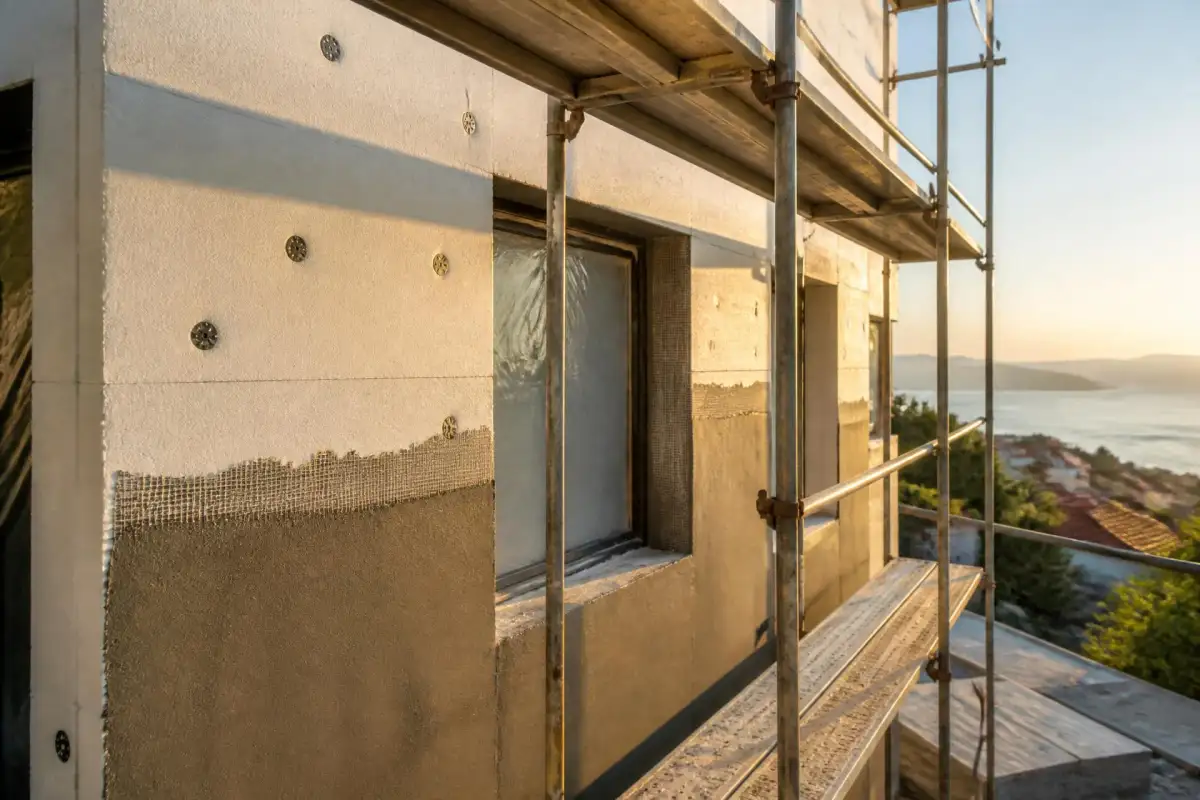
Insulated walls need a certified matched system — standard render cracks and comes away.
Standard lead time on masonry, screeds & renders is 3–10 days from confirmed specification, and that window covers the whole chain — factory programming, consolidation, transport, customs where applicable and delivery to site or to your warehouse. We quote the landed number, not an ex-works price that grows later.
Pricing is per project rather than per line. Because we import directly and consolidate masonry, screeds & renders with the rest of the materials for the same room, you get one quote, one delivery window and one point of contact — and the savings show up on the total, not just on a headline reference.
If you already have drawings, send them and we will come back with a specification and a landed price. If you do not, we will build the specification with you first. Either way, nothing is ordered until the quantities, finishes and dates are agreed in writing.
Yes. Send the drawings and we return a take-off: blocks per wall, mortar per m², render per surface, screed per m³, with a realistic waste allowance rather than an optimistic one.
Above roughly 200 m², machine application is faster, more consistent and usually cheaper per m² once labour is counted. Small areas and complex detailing still make sense by hand.
A fibre-reinforced or additive-modified screed at the thickness the system requires above the pipe, with perimeter strips and movement joints. We specify it alongside the underfloor package so the two agree.
As a guide, about one week per centimetre of thickness for a cement screed in normal conditions, verified with a moisture reading. Rapid-set screeds cut that substantially where the programme is tight.
Yes, palletised through our logistics partners, with delivery windows confirmed at order so the crew isn't waiting on a ferry.
Yes — but that runs as a certified ETICS package with matched adhesive, mesh and finish. See our external thermal insulation category.