01 / 04
One coordinated spec instead of three suppliers
Cable, panel, wiring devices and controls are specified together, so the electrician isn't reconciling three separate orders.
One spec, not three separate suppliers
Cable, distribution panels, breakers, wiring devices and smart controls, imported and stocked.
Electrical material is where a project quietly loses time. We import and distribute the whole chain — cable and conduit, distribution panels and protection, sockets and switches in designed finishes, dimmers and smart controls — so the electrician, the architect and the lighting scheme are all working from one coordinated specification instead of three suppliers.
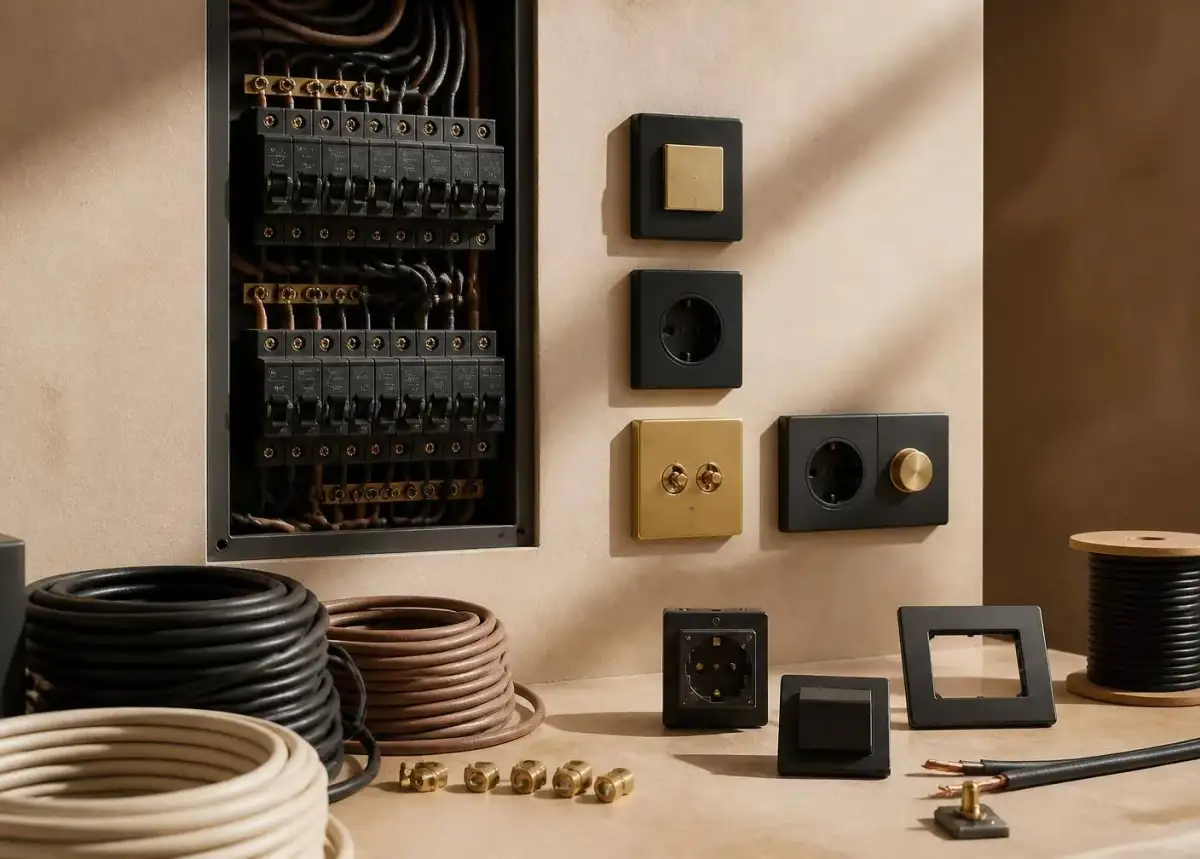
Sockets, switches, dimmers and thermostats are usually the last thing bought and the cheapest thing chosen, and a mismatched driver and dimmer is the single biggest cause of a flicker complaint after handover. We import wiring device families in designed finishes and check the technical match before the order is confirmed, so the electrician isn't back on site for a fault that should never have happened.
Driver and dimmer checked against each other before the order ships — no flicker, no return visit.
Behind the plate, we supply the whole chain: cable and conduit, distribution boards, MCBs, RCBOs and surge protection sized to the load schedule, plus the dimming and control gear checked against the actual luminaires. Verifying driver type against dimmer type before the order is what removes the flicker problem that otherwise costs a re-visit per room.
Electrical bought piecemeal is where flicker faults and mismatched finishes both start. We coordinate cable, panel, devices and lighting controls as one specification.
Cable, panel, wiring devices and controls are specified together, so the electrician isn't reconciling three separate orders.
One spec, not three separate suppliers
Matte black, brushed brass and off-white device families chosen to sit with the lighting and brassware already specified.
Finish-matched to lighting and brassware
Driver type and dimming protocol verified against the actual luminaires, eliminating the flicker callback.
No flicker callbacks after handover
Panels and protection sized against the real load schedule, with spare capacity for the years after handover.
Sized with spare capacity, not just today's load
NYM, NYY, halogen-free and data cable, plus conduit, trunking and boxes for the full installation.
Distribution boards, MCBs, RCBOs, contactors and surge protection sized to the load schedule.
Wiring device families in designed finishes, with matching data, USB-C and TV outlets.
Phase-cut, 0–10V, DALI and wireless dimming matched to the lighting specification.
IP-rated boxes, garden and facade circuits, pump and HVAC feeds.

A rewire is the only chance to get socket positions, data points and dimming right. Device family and finish are chosen with the lighting, and the board is sized for the loads the house will actually have in ten years.

Hotel rooms need bedside master switches, simple scene buttons and hardware that survives suitcases. Control gear is centralised so a room fault is fixed in the riser, not on the guest's wall.

Retail changes layout constantly, so power and lighting have to be flexible: multi-circuit track, floor boxes on a grid, and DALI addressing that lets a shop be re-zoned in software instead of with a ladder.

Garden and facade circuits fail at the junction box, not at the fitting. IP66 enclosures, correct glands, UV-stable cable and separate RCD protection for anything outside the building line.
Cable,distributionpanels,breakers,wiringdevicesandsmartcontrols,importedandstocked.
Phase-cut, 0–10V and DALI are separate worlds, and confirming the luminaire driver first is what eliminates the majority of dimming complaints that otherwise mean a return visit per room.
Under-sizing the board means adding circuits later requires a whole new board, not a spare fuse — a far more disruptive and costly job than getting it right up front.
Choosing switch plates after the lighting is already ordered is how a project ends up with mismatched finishes on the wall — a small detail that undermines an otherwise expensive-looking room.
Cat6 to TV positions, desks and access points costs little during first fix and becomes a major disruption once walls are closed up — this is a decision with no cheap way back.
Standard cable in a hotel, office or public space where people gather is a life-safety exposure, not a cost saving — LSZH is the decision that removes that risk.
Outlets fixed without checking the furniture plan end up behind sofas and beds, unreachable on the day the client actually needs them.
One storm without surge protection can take out every driver in a lighting scheme at once — a full re-lamp bill against the cost of a single device in the board.
LED loads are small, and many dimmers have a minimum load below which lights buzz or refuse to dim — a callback that traces back to a mismatch made at order stage, not a faulty fitting.
Representative selections from the catalog — indicative of what we quote, stock-source and deliver week to week. Ask for the full schedule with formats, finishes and current lead times.
01NYM, NYY, halogen-free and data cable, plus conduit, trunking and boxes for the full installation.
02Distribution boards, MCBs, RCBOs, contactors and surge protection sized to the load schedule.
03Wiring device families in designed finishes, with matching data, USB-C and TV outlets.
04Phase-cut, 0–10V, DALI and wireless dimming matched to the lighting specification.
Electrical bought piecemeal is where flicker faults and mismatched finishes both start. We coordinate cable, panel, devices and lighting controls as one specification. This is the part most suppliers leave out: what we import, how electrical should be specified before anyone prices it, where projects lose money, and what our 1–2 wks lead time actually covers.
Electrical material is where a project quietly loses time. We import and distribute the whole chain — cable and conduit, distribution panels and protection, sockets and switches in designed finishes, dimmers and smart controls — so the electrician, the architect and the lighting scheme are all working from one coordinated specification instead of three suppliers.
Because we buy electrical directly from the factories, the range you see is the range we can programme — not a catalogue we hope to source later. In practice that means cable & conduit, panels & protection and sockets & switches, each with its own price band and availability, so a specification can be tuned to a budget instead of abandoned.
One coordinated spec instead of three suppliers: cable, panel, wiring devices and controls are specified together, so the electrician isn't reconciling three separate orders.
Driver and dimmer checked against each other before the order ships — no flicker, no return visit.
Cable, panel, wiring devices and controls are specified together, so the electrician isn't reconciling three separate orders.
Matte black, brushed brass and off-white device families chosen to sit with the lighting and brassware already specified.
Driver type and dimming protocol verified against the actual luminaires, eliminating the flicker callback.
Panels and protection sized against the real load schedule, with spare capacity for the years after handover.
Specifying electrical well comes down to a short list of decisions taken in the right order — decide the driver before you decide the dimmer, decide the board size from a load schedule, not a guess, decide the device family with the lighting scheme, not separately and decide data points now, because retrofitting them is nearly impossible. Taken on paper, these cost nothing. Taken on site, each one is a change order.
We write the specification with you before anything is quoted, so the number you get is for the material that will actually be installed. That means confirmed dimensions and finishes, the right performance class for the space, and quantities that include the waste factor rather than discovering it mid-installation.
The same reference behaves differently depending on where it goes — residential rewires, hotels, retail & offices and short-term rentals each carry their own requirements, and we specify against the space rather than against a mood image.
Combined residual current and overcurrent protection on a single circuit.
Surge protection device installed in the distribution board.
Low smoke zero halogen cable, required in public and escape routes.
Leading or trailing edge dimming, the common residential method.
Almost every delay we are called in to rescue traces back to the same handful of causes: socket positions decided without furniture, no surge protection, dimmer load range ignored and routing cable without checking other services. None of them are exotic, and all of them are avoidable at specification stage.
Socket positions decided without furniture is the most expensive one, because outlets fixed without checking the furniture plan end up behind sofas and beds, unreachable on the day the client actually needs them.
We have supplied electrical into residential rewires, hotels & rentals and retail & offices, and the pattern is consistent: the projects that run smoothly are the ones where the material was locked before the trades were booked.
No surge protection — checked once on paper, never again on site.
Outlets fixed without checking the furniture plan end up behind sofas and beds, unreachable on the day the client actually needs them.
One storm without surge protection can take out every driver in a lighting scheme at once — a full re-lamp bill against the cost of a single device in the board.
LED loads are small, and many dimmers have a minimum load below which lights buzz or refuse to dim — a callback that traces back to a mismatch made at order stage, not a faulty fitting.
A cable run alongside a hot water pipe or crossing an underfloor heating zone without clearance can fail as nuisance tripping or heat degradation months after the walls are closed and the cause is no longer visible.
Standard lead time on electrical is 1–2 wks from confirmed specification, and that window covers the whole chain — factory programming, consolidation, transport, customs where applicable and delivery to site or to your warehouse. We quote the landed number, not an ex-works price that grows later.
Pricing is per project rather than per line. Because we import directly and consolidate electrical with the rest of the materials for the same room, you get one quote, one delivery window and one point of contact — and the savings show up on the total, not just on a headline reference.
If you already have drawings, send them and we will come back with a specification and a landed price. If you do not, we will build the specification with you first. Either way, nothing is ordered until the quantities, finishes and dates are agreed in writing.
Send the load schedule or panel drawing and we return a priced material list for the board and circuits, quoted per project rather than per item.
Cable and standard wiring devices can be ordered in project quantities without a fixed minimum; designed finish ranges are typically ordered as one batch per project.
Common cable sizes, breakers and standard wiring devices are held locally, with designed finishes and smart control gear programmed at 1–2 weeks.
Yes, samples of the wiring device finish are available, and the finish can be checked in 3D against the lighting and joinery it needs to match.
Yes, send the schedule and we return a priced list for the panel, breakers, protection and circuits, matched to the actual load.
Wiring devices are chosen in the same finish family as the luminaires and ironmongery, so the visible hardware reads as one decision.
We check driver type and dimming protocol against the specified luminaires before quoting, since mismatched dimming is the most common cause of flicker.
Yes, ranges are chosen for ongoing availability so panels and wiring devices can be extended or repaired without redesigning the installation.
Yes, we supply trade electricians and developers nationwide, coordinating delivery with the panel installation and lighting fit-out schedule.
Materials from this category are usually specified for lighting design and office fit-out. If your project needs installation as well as supply, we handle both together.