01 / 04
Programmed around your routine, not a demo template
Scenes and schedules are built from how you actually move through the house — morning, arrival, night — not a generic 'party mode' left unused.
Scene logic built from your actual routine
KNX actuators, touch panels, lighting/blind/climate control, wireless alternatives and programming.
KNX building automation for lighting, blinds and climate, plus wireless alternatives where a full bus retrofit isn't practical. We supply actuators, touch panels and sensors, and handle the programming logic — scenes, schedules and room-by-room control — around how the house or building is actually used, not a generic demo setup left for you to figure out.
The biggest difference between a KNX installation and a consumer smart-home kit isn't the interface — it's what happens in ten years. KNX is an open international standard with a documented programming file (ETS), meaning any certified integrator can service or extend it later. A closed wireless ecosystem depends on one manufacturer staying in business and keeping the app updated.
KNX outlives the app on your phone. It's a wired standard that any certified integrator can service in ten years — a proprietary smart-home app usually can't say the same.
We design the wiring topology at first-fix stage — lighting circuits, blind motors and climate actuators all on the KNX bus — then program scenes, schedules and climate logic in ETS before handover. Where new wiring isn't possible, such as a renovation, we spec a wireless KNX-compatible layer instead of ripping out finished walls, keeping the same open standard rather than switching to a closed alternative.
Lighting, blinds and climate are designed and programmed as one KNX system with a documented ETS file handed over at completion, instead of a stack of separate wireless apps that stop talking to each other after an update.
Scenes and schedules are built from how you actually move through the house — morning, arrival, night — not a generic 'party mode' left unused.
Scene logic built from your actual routine
Renovations that can't take new cabling get a wireless KNX-compatible layer instead of ripping out finished walls for a bus cable.
Wireless option avoids unnecessary wall opening
All three run through the same panel and app instead of three separate manufacturer apps that don't talk to each other.
Lighting, blinds and climate on one interface
The project file and programming logic are handed over documented, so a future electrician or installer isn't locked out of your own system.
Full project file handed over, not locked in
Switching, dimming and blind actuators for DIN-rail installation in the distribution board
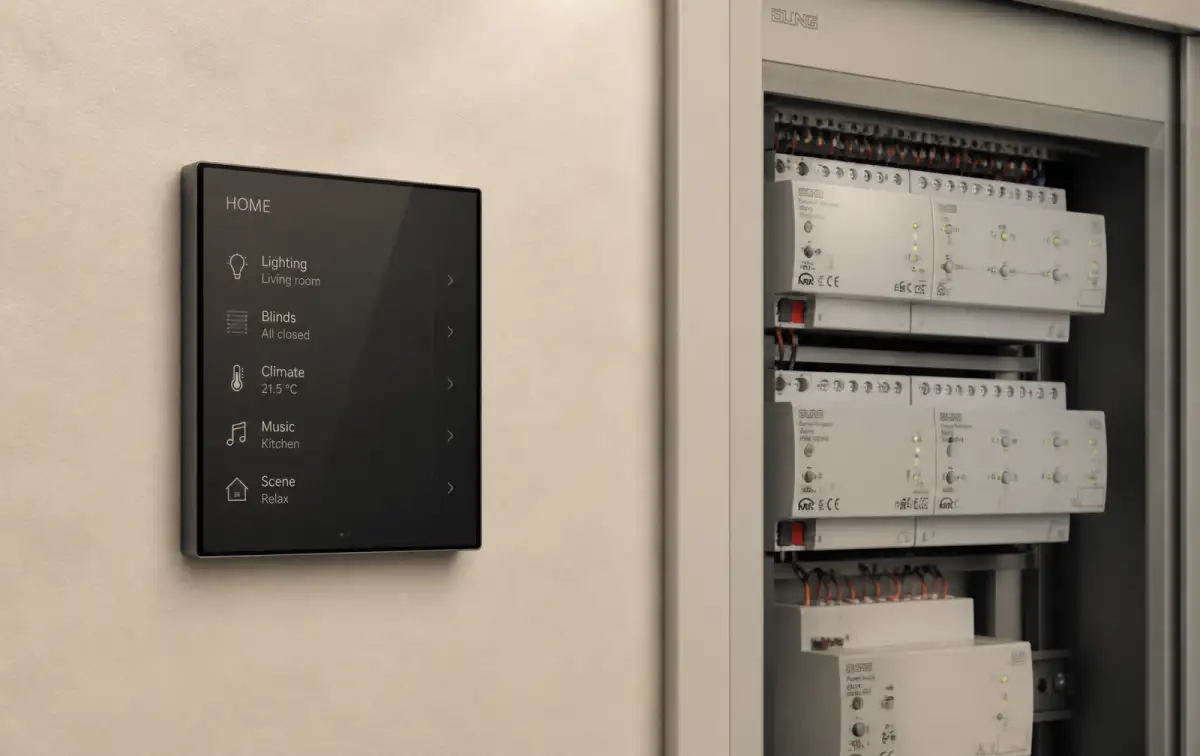
Wall-mounted touch panels, presence detectors and multi-sensors for scene triggering
Dimming and switching circuits programmed into scenes, schedules and presence-based logic
Motorised blind and shutter actuators with sun-position and wind-safety logic
Thermostats and valve actuators integrated with underfloor heating and AC for room-by-room control
Wireless smart-home layers for renovations where new bus cabling isn't practical
One panel, one system, scenes that actually get used.
Lighting circuits are wired to the KNX bus at first-fix and programmed into scenes — evening, cinema, away — controlled from wall panels, an app or voice integration, all from the same underlying system rather than three overlapping apps.
Blinds that respond to sun position, not just a timer.
Motorised blinds are integrated on the same bus as lighting and climate, so shading can respond to sun position and indoor temperature automatically, reducing cooling load in summer without manual adjustment every afternoon.
Zoned heating and cooling, programmed room by room.
Underfloor heating, heat pumps and AC units are integrated into zoned climate control on the same KNX bus, with schedules programmed per room so unoccupied bedrooms aren't conditioned to the same schedule as the living room.

A wireless KNX-compatible layer where walls can't be opened.
Where a full rewire isn't practical, wireless KNX-compatible actuators and sensors extend the same open standard without disturbing finished plaster, giving a renovation the same long-term serviceability as a new-build install.
Bus cable runs alongside power circuits and needs planning before walls close — retrofitting later usually means a wireless layer instead.
Programming generic 'morning' and 'evening' scenes without asking how a household actually uses each room wastes the system's real value.
Every circuit, blind motor and sensor needs its own bus device — we size this from your electrical drawings before ordering hardware.
The programming file is what lets any certified integrator service the system in future — without it you're locked to the original installer.
Automation should never remove the option of a manual switch — every scene and shading rule keeps a physical override in reach.
Where new cabling isn't practical, KNX-compatible wireless devices keep you on the same open standard rather than switching to a closed system.
A proprietary app-based system depends on one manufacturer staying supported — KNX's open standard doesn't carry that risk.
Bus cable is far cheaper to run at first-fix than retrofitted later — this decision needs making with the electrician, not after.
A scene set that doesn't match how the household actually lives gets switched off within weeks — we design scenes around real routines.
Representative selections from the catalog — indicative of what we quote, stock-source and deliver week to week. Ask for the full schedule with formats, finishes and current lead times.
01Switching, dimming and blind actuators for DIN-rail installation in the distribution board
02Wall-mounted touch panels, presence detectors and multi-sensors for scene triggering
03Dimming and switching circuits programmed into scenes, schedules and presence-based logic
04Motorised blind and shutter actuators with sun-position and wind-safety logic
Lighting, blinds and climate are designed and programmed as one KNX system with a documented ETS file handed over at completion, instead of a stack of separate wireless apps that stop talking to each other after an update. This is the part most suppliers leave out: what we import, how KNX & smart home should be specified before anyone prices it, where projects lose money, and what our 2–4 wks lead time actually covers.
KNX building automation for lighting, blinds and climate, plus wireless alternatives where a full bus retrofit isn't practical. We supply actuators, touch panels and sensors, and handle the programming logic — scenes, schedules and room-by-room control — around how the house or building is actually used, not a generic demo setup left for you to figure out.
Because we buy KNX & smart home directly from the factories, the range you see is the range we can programme — not a catalogue we hope to source later. In practice that means KNX actuators, touch panels & sensors and lighting control, each with its own price band and availability, so a specification can be tuned to a budget instead of abandoned.
Programmed around your routine, not a demo template: scenes and schedules are built from how you actually move through the house — morning, arrival, night — not a generic 'party mode' left unused.
KNX outlives the app on your phone. It's a wired standard that any certified integrator can service in ten years — a proprietary smart-home app usually can't say the same.
Scenes and schedules are built from how you actually move through the house — morning, arrival, night — not a generic 'party mode' left unused.
Renovations that can't take new cabling get a wireless KNX-compatible layer instead of ripping out finished walls for a bus cable.
All three run through the same panel and app instead of three separate manufacturer apps that don't talk to each other.
The project file and programming logic are handed over documented, so a future electrician or installer isn't locked out of your own system.
Specifying KNX & smart home well comes down to a short list of decisions taken in the right order — decide KNX wiring at first-fix, not after plastering, choose scenes around how you actually live, confirm actuator count before ordering and insist on the ETS file at handover. Taken on paper, these cost nothing. Taken on site, each one is a change order.
We write the specification with you before anything is quoted, so the number you get is for the material that will actually be installed. That means confirmed dimensions and finishes, the right performance class for the space, and quantities that include the waste factor rather than discovering it mid-installation.
The same reference behaves differently depending on where it goes — new-build houses and villas, renovations needing wireless control, hotels and serviced apartments, offices and meeting rooms each carry their own requirements, and we specify against the space rather than against a mood image.
An open international standard for building automation covering lighting, blinds, climate and more, supported by many manufacturers.
The standard software used to program a KNX installation, producing a documented file any certified integrator can read.
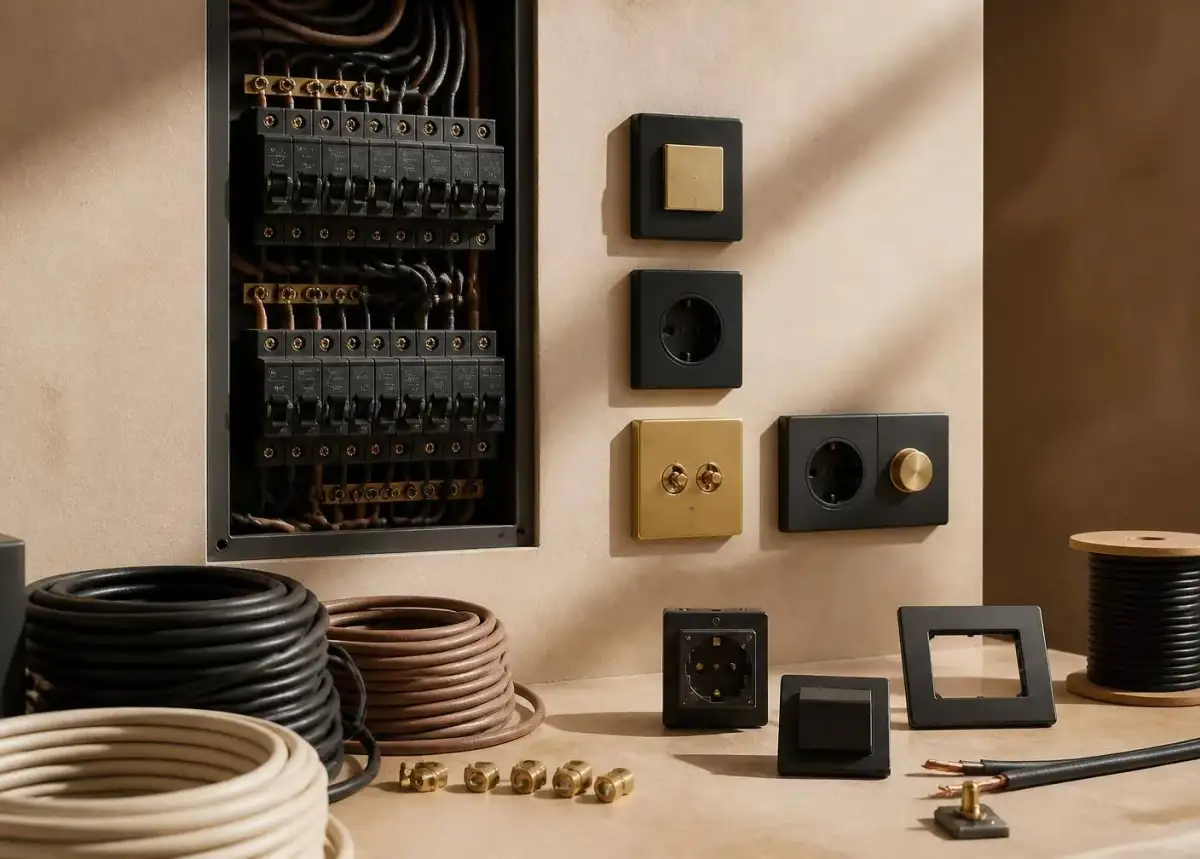
The dedicated low-voltage cable that carries KNX communication between devices, run alongside standard power wiring.
A KNX bus device that controls an output such as a light circuit, blind motor or heating valve.
Almost every delay we are called in to rescue traces back to the same handful of causes: choosing a closed wireless smart-home kit for a new-build, deciding wiring after the walls are closed, programming generic scenes without discussing daily routines and not requesting the ETS programming file. None of them are exotic, and all of them are avoidable at specification stage.
Choosing a closed wireless smart-home kit for a new-build is the most expensive one, because a proprietary app-based system depends on one manufacturer staying supported — KNX's open standard doesn't carry that risk.
We have supplied KNX & smart home into residential lighting & scenes, blinds & shading and climate control, and the pattern is consistent: the projects that run smoothly are the ones where the material was locked before the trades were booked.
Deciding wiring after the walls are closed — checked once on paper, never again on site.
A proprietary app-based system depends on one manufacturer staying supported — KNX's open standard doesn't carry that risk.
Bus cable is far cheaper to run at first-fix than retrofitted later — this decision needs making with the electrician, not after.
A scene set that doesn't match how the household actually lives gets switched off within weeks — we design scenes around real routines.
Without it, only the original installer can service or extend the system — the file should be handed over as standard at completion.
Standard lead time on KNX & smart home is 2–4 wks from confirmed specification, and that window covers the whole chain — factory programming, consolidation, transport, customs where applicable and delivery to site or to your warehouse. We quote the landed number, not an ex-works price that grows later.
Pricing is per project rather than per line. Because we import directly and consolidate KNX & smart home with the rest of the materials for the same room, you get one quote, one delivery window and one point of contact — and the savings show up on the total, not just on a headline reference.
If you already have drawings, send them and we will come back with a specification and a landed price. If you do not, we will build the specification with you first. Either way, nothing is ordered until the quantities, finishes and dates are agreed in writing.
For new builds and full renovations, yes — a KNX bus cable runs alongside standard wiring to every control point. For finished properties, a wireless KNX-compatible layer avoids opening walls, at a small trade-off in flexibility.
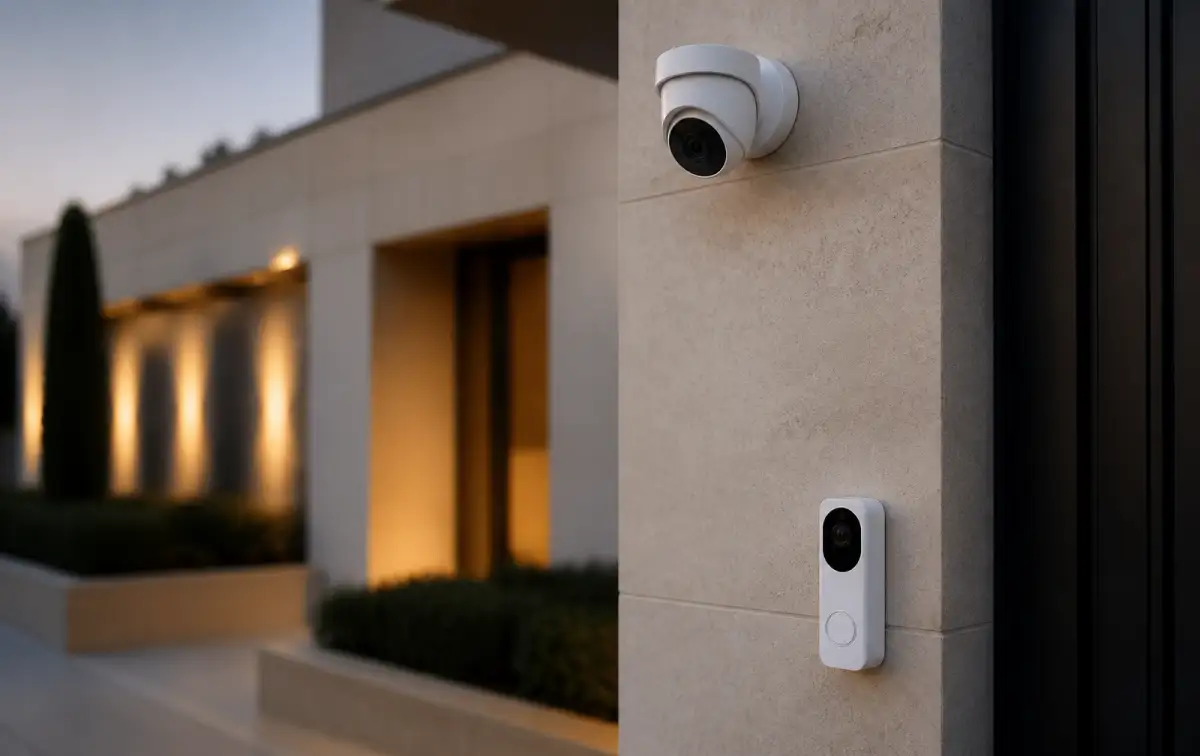
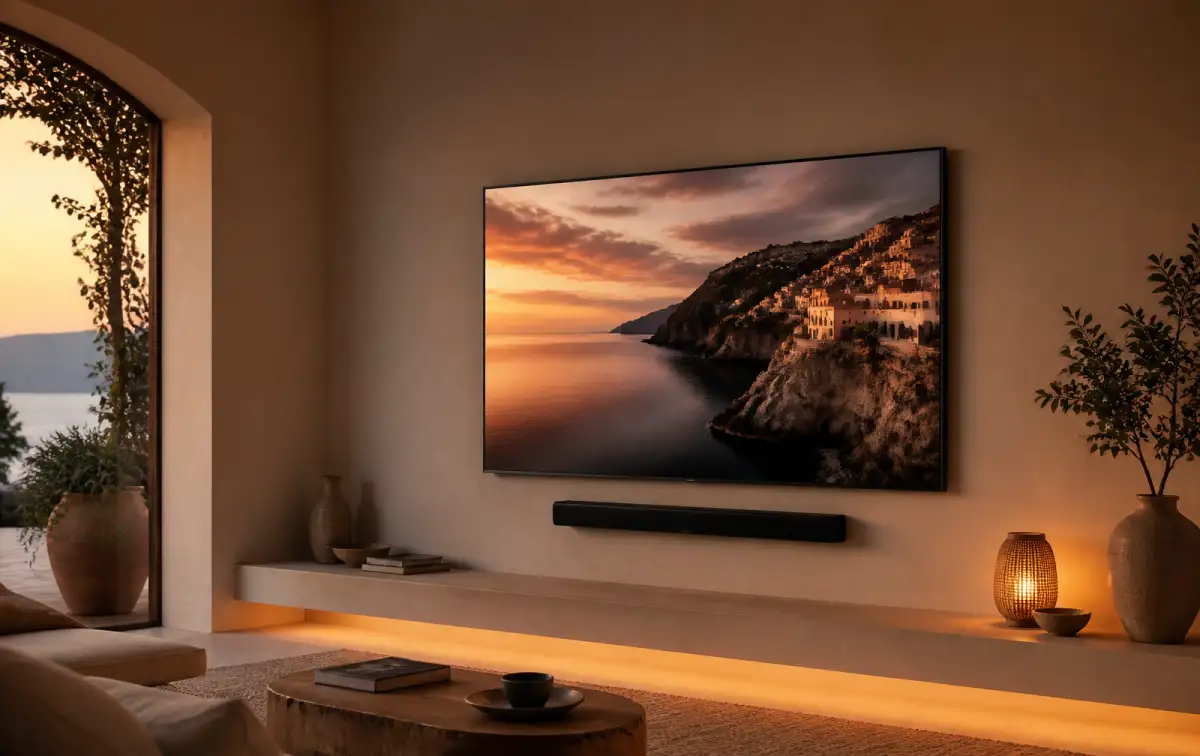
Lighting, blinds and shutters, heating and cooling, and integration with cameras, alarms and audio are all standard — programmed together so one scene, like 'leaving home', adjusts all of it at once.
KNX is more reliable long-term because it runs on a dedicated wired bus rather than WiFi, and it's an open standard so you're not locked to one brand. Wireless systems install faster and suit renovations where cabling isn't realistic.
We program it with you, working through your actual routine — morning, arrival, night, away — rather than leaving a generic factory setup for you to configure yourself.
You receive the full documented project file, so any KNX-certified installer can open and modify the programming — you are not locked into one company to make a change.
Typically 2–4 weeks from confirmed scope to commissioning, including a dedicated programming visit once the electrical first-fix is complete.
Materials from this category are usually specified for lighting design and interior design projects. If your project needs installation as well as supply, we handle both together.