01 / 04
Coverage planned from the actual site, not a generic count
We walk the plan or the plot to find real blind spots — gates, side access, pool areas — before proposing camera positions and count.
Camera plan drawn from a site walk-through
IP cameras, NVRs, video doorbells and alarm integration, installed with GDPR in mind.
IP camera systems, network video recorders, video doorbells and alarm-panel integration for homes, developments and commercial sites. We walk the plan or the site first to identify actual coverage gaps and blind spots, then specify camera count, resolution and storage against that — and we flag the signage and retention requirements a GDPR-aware installation needs, especially where footage covers shared or public space.
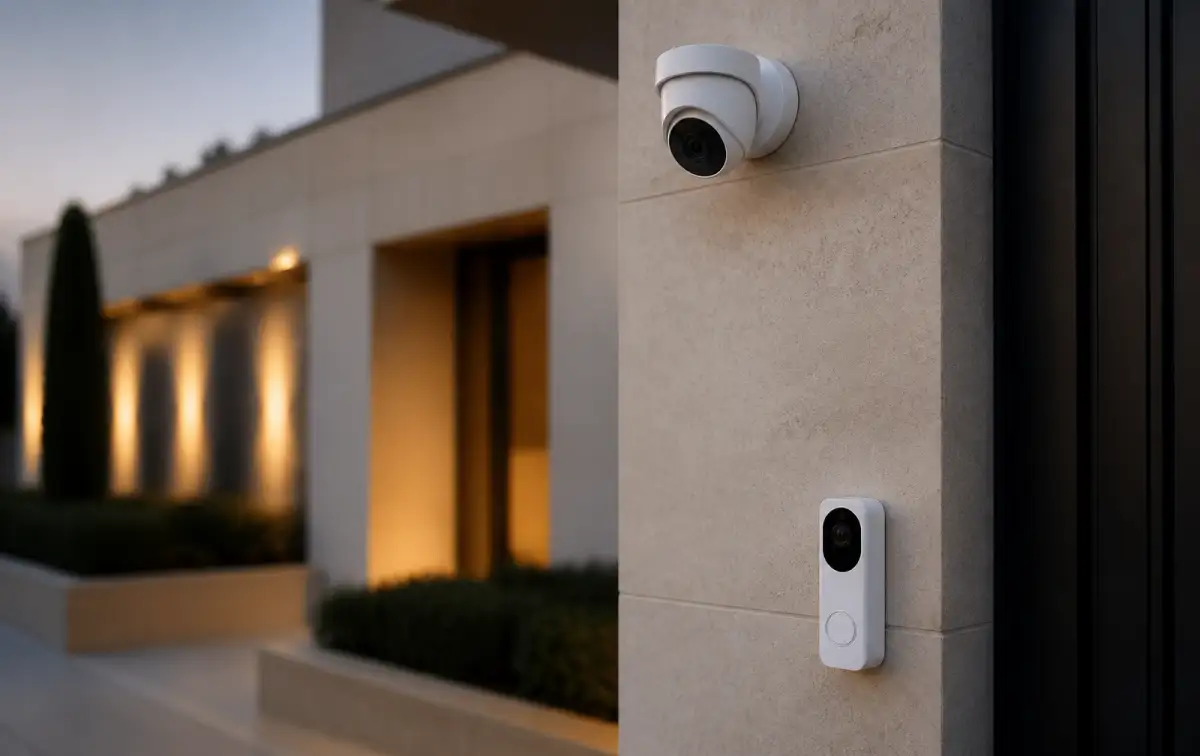
A camera brochure shows perfect footage in daylight. What decides real-world performance is placement, lighting at night, and whether the recorder has enough storage and bandwidth for the number of cameras actually installed. We survey the site, plan camera positions against real blind spots and lighting conditions, and size the recorder and network to match — not the other way round.
A camera system is only as good as its storage and its network. The camera itself is the cheapest part of the quote.
Every residential and commercial install includes the GDPR side that's easy to overlook: required signage, a documented retention period, and a clear answer to who can access footage and for how long. Doorbell cameras, perimeter coverage and internal monitoring are specified together so the whole property is covered by one coherent system rather than a mix of incompatible apps.
Cameras, recorder, network cabling and GDPR-compliant signage are designed and quoted as one system, so coverage, storage and legal compliance are solved together instead of left to whoever fits the cameras later.
We walk the plan or the plot to find real blind spots — gates, side access, pool areas — before proposing camera positions and count.
Camera plan drawn from a site walk-through
Reading a number plate needs different resolution than confirming a delivery arrived. We size cameras and retention days to the actual use case.
Resolution and retention sized per use case
Camera angles are checked against neighbouring properties and public areas, with signage and retention periods flagged before installation.
Angles and retention checked against GDPR exposure
Cameras, sensors and the alarm panel are specified to work as one system with one app, instead of three disconnected apps on your phone.
One system, one app, alarm and cameras together
Dome, bullet and turret IP cameras from 2MP to 8MP, with IR and colour-night variants
Network video recorders with PoE switching and HDD storage sized to camera count and retention period
WiFi doorbell cameras with two-way audio, integrated with the main system or standalone
Motion sensors, door/window contacts and panels integrated with the camera system on one app
Video intercoms, gate cameras and card/PIN entry for shared entrances and developments

Doorbell and perimeter coverage that actually connects.
Video doorbells and perimeter cameras are specified together on one app and one recorder, with night-time lighting and camera placement checked on site so footage is actually usable in the dark, not just present.
Coverage designed against your actual blind spots.
Till points, stockrooms and entrances are surveyed for genuine blind spots rather than an even spread of cameras, with storage sized to your retention policy and footage export tested before handover.
Full-site coverage with a documented GDPR policy.
Corridors, entrances, car parks and back-of-house areas are covered under one system with a documented retention and access policy, plus the guest-facing signage required for compliance handed over as part of the install.
Access control integrated with recorded coverage.
Entrances, loading bays and server rooms are covered with a system that can integrate with existing access control, giving a recorded trail alongside door entry logs rather than two separate, disconnected systems.
Blind spots, night lighting and mounting height decide real coverage — a symmetric layout on a drawing rarely matches what's actually needed on site.
Recorder storage is sized from camera count, resolution and required retention days — decide the retention policy before buying the recorder.
High-resolution cameras need real bandwidth to stream and record — we check your network capacity before specifying resolution.
Recording public or semi-public areas legally requires signage and a documented retention policy — we include both in the handover pack.
A system that only works from the on-site screen isn't useful for an owner who travels — remote viewing is tested as part of commissioning.
A recorder and network sized with no spare capacity means a full upgrade later — we build in headroom for one or two extra cameras from the start.
A recorder undersized for the camera count and resolution runs out of storage days faster than expected — size both together.
An evenly spaced layout often leaves the actual entry points uncovered — placement should follow the real risk, not a neat grid.
Recording without the required signage and documented policy is a compliance gap that's simple to close at install time.
Representative selections from the catalog — indicative of what we quote, stock-source and deliver week to week. Ask for the full schedule with formats, finishes and current lead times.
01Dome, bullet and turret IP cameras from 2MP to 8MP, with IR and colour-night variants
02Network video recorders with PoE switching and HDD storage sized to camera count and retention period
03WiFi doorbell cameras with two-way audio, integrated with the main system or standalone
04Motion sensors, door/window contacts and panels integrated with the camera system on one app
Cameras, recorder, network cabling and GDPR-compliant signage are designed and quoted as one system, so coverage, storage and legal compliance are solved together instead of left to whoever fits the cameras later. This is the part most suppliers leave out: what we import, how security cameras & CCTV should be specified before anyone prices it, where projects lose money, and what our 1–3 wks lead time actually covers.
IP camera systems, network video recorders, video doorbells and alarm-panel integration for homes, developments and commercial sites. We walk the plan or the site first to identify actual coverage gaps and blind spots, then specify camera count, resolution and storage against that — and we flag the signage and retention requirements a GDPR-aware installation needs, especially where footage covers shared or public space.
Because we buy security cameras & CCTV directly from the factories, the range you see is the range we can programme — not a catalogue we hope to source later. In practice that means IP cameras, NVRs & storage and video doorbells, each with its own price band and availability, so a specification can be tuned to a budget instead of abandoned.
Coverage planned from the actual site, not a generic count: we walk the plan or the plot to find real blind spots — gates, side access, pool areas — before proposing camera positions and count.
A camera system is only as good as its storage and its network. The camera itself is the cheapest part of the quote.
We walk the plan or the plot to find real blind spots — gates, side access, pool areas — before proposing camera positions and count.
Reading a number plate needs different resolution than confirming a delivery arrived. We size cameras and retention days to the actual use case.
Camera angles are checked against neighbouring properties and public areas, with signage and retention periods flagged before installation.
Cameras, sensors and the alarm panel are specified to work as one system with one app, instead of three disconnected apps on your phone.
Specifying security cameras & CCTV well comes down to a short list of decisions taken in the right order — survey the site before placing a single camera, size storage to your retention requirement first, check network bandwidth before adding 4K cameras, confirm GDPR signage and retention policy at install. Taken on paper, these cost nothing. Taken on site, each one is a change order.
We write the specification with you before anything is quoted, so the number you get is for the material that will actually be installed. That means confirmed dimensions and finishes, the right performance class for the space, and quantities that include the waste factor rather than discovering it mid-installation.
The same reference behaves differently depending on where it goes — houses and villas, apartment building common areas, retail and commercial premises, warehouses and construction sites each carry their own requirements, and we specify against the space rather than against a mood image.
The recorder that stores footage from IP cameras over the network, as opposed to older analogue DVR systems.
A network-connected camera that sends digital video over Ethernet or Wi-Fi rather than an analogue cable.
The length of time recorded footage is kept before being automatically overwritten.
An on-site assessment identifying areas a camera layout would fail to cover.
Almost every delay we are called in to rescue traces back to the same handful of causes: buying cameras before sizing the recorder, placing cameras symmetrically instead of by blind spot, skipping GDPR signage and ignoring network capacity for 4K cameras. None of them are exotic, and all of them are avoidable at specification stage.
Buying cameras before sizing the recorder is the most expensive one, because a recorder undersized for the camera count and resolution runs out of storage days faster than expected — size both together.
We have supplied security cameras & CCTV into homes & entrances, retail & commercial premises and hotels & hospitality, and the pattern is consistent: the projects that run smoothly are the ones where the material was locked before the trades were booked.
Placing cameras symmetrically instead of by blind spot — checked once on paper, never again on site.
A recorder undersized for the camera count and resolution runs out of storage days faster than expected — size both together.
An evenly spaced layout often leaves the actual entry points uncovered — placement should follow the real risk, not a neat grid.
Recording without the required signage and documented policy is a compliance gap that's simple to close at install time.
High-resolution streams can overwhelm an unprepared network, causing dropped footage exactly when it's needed most.
Standard lead time on security cameras & CCTV is 1–3 wks from confirmed specification, and that window covers the whole chain — factory programming, consolidation, transport, customs where applicable and delivery to site or to your warehouse. We quote the landed number, not an ex-works price that grows later.
Pricing is per project rather than per line. Because we import directly and consolidate security cameras & CCTV with the rest of the materials for the same room, you get one quote, one delivery window and one point of contact — and the savings show up on the total, not just on a headline reference.
If you already have drawings, send them and we will come back with a specification and a landed price. If you do not, we will build the specification with you first. Either way, nothing is ordered until the quantities, finishes and dates are agreed in writing.
There's no fixed number — it depends on entry points, blind spots and what you need to see clearly. We walk the plan or the plot and propose positions based on real gaps, not a generic package size.
Local NVR storage avoids ongoing subscription costs and keeps footage on-site, while cloud storage survives a stolen or damaged recorder. Many installs run both for the entrances that matter most.
Generally no, or only with restrictions and clear signage — cameras should be angled to cover your own property. We check angles at the design stage specifically to flag this before installation.
Yes, when specified together they run through one panel and one app, so a triggered sensor pulls up the relevant camera feed automatically instead of you checking two separate apps.
Typically 7–30 days depending on storage size and camera count, sized to what you actually need — for most residential use, 14 days covers the realistic window to review an incident.
Yes, they can be supplied and installed on their own or as part of a wider camera and alarm system, integrated into the same app either way.
Materials from this category are usually specified for retail fit-out and office fit-out. If your project needs installation as well as supply, we handle both together.